
Writing Amid the Rubble: Life and Loss in Gaza
By Maria Lammerding
“The war destroyed all the dreams,” Amer says, simply.
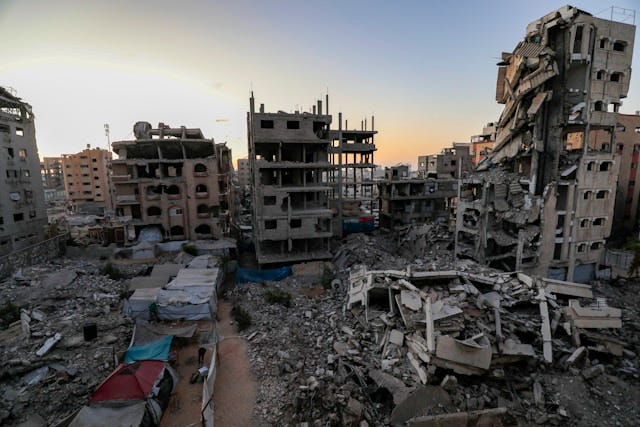
Photo by Mohammed Ibrahim
There are conversations that make you acutely aware of your own circumstances. Speaking with Ruwaida Amer was one of them.
As I sat in Melbourne, surrounded by routine and relative certainty, she spoke from Gaza, where uncertainty governs every aspect of life. The contrast between our worlds did not need to be stated, it revealed itself in the cadence of her voice and in what she described.
Amer is a teacher and journalist. She was born into a refugee family displaced during the years of Israel’s formation. Her early childhood was spent in a refugee camp in Khan Yunis, where she lived for eight years before it was razed by the Israeli military in 2000. Her family was forced to move to the agricultural area of Al Fukhari, east of Khan Yunis, where displacement became a recurring condition rather than a singular event. Since the current invasion, she and her elderly parents have been displaced several times.
Still, she continues to bear witness.
That commitment runs through Stories from the War on Gaza, a recently published collection of Amer’s journalism written for various news outlets. The work documents daily life under siege, tracing the cumulative impact of Israel’s war on Gaza and its people. Taken together, the pieces reveal both immense hardship and the endurance of communities forced to live in the shadow of conflict.
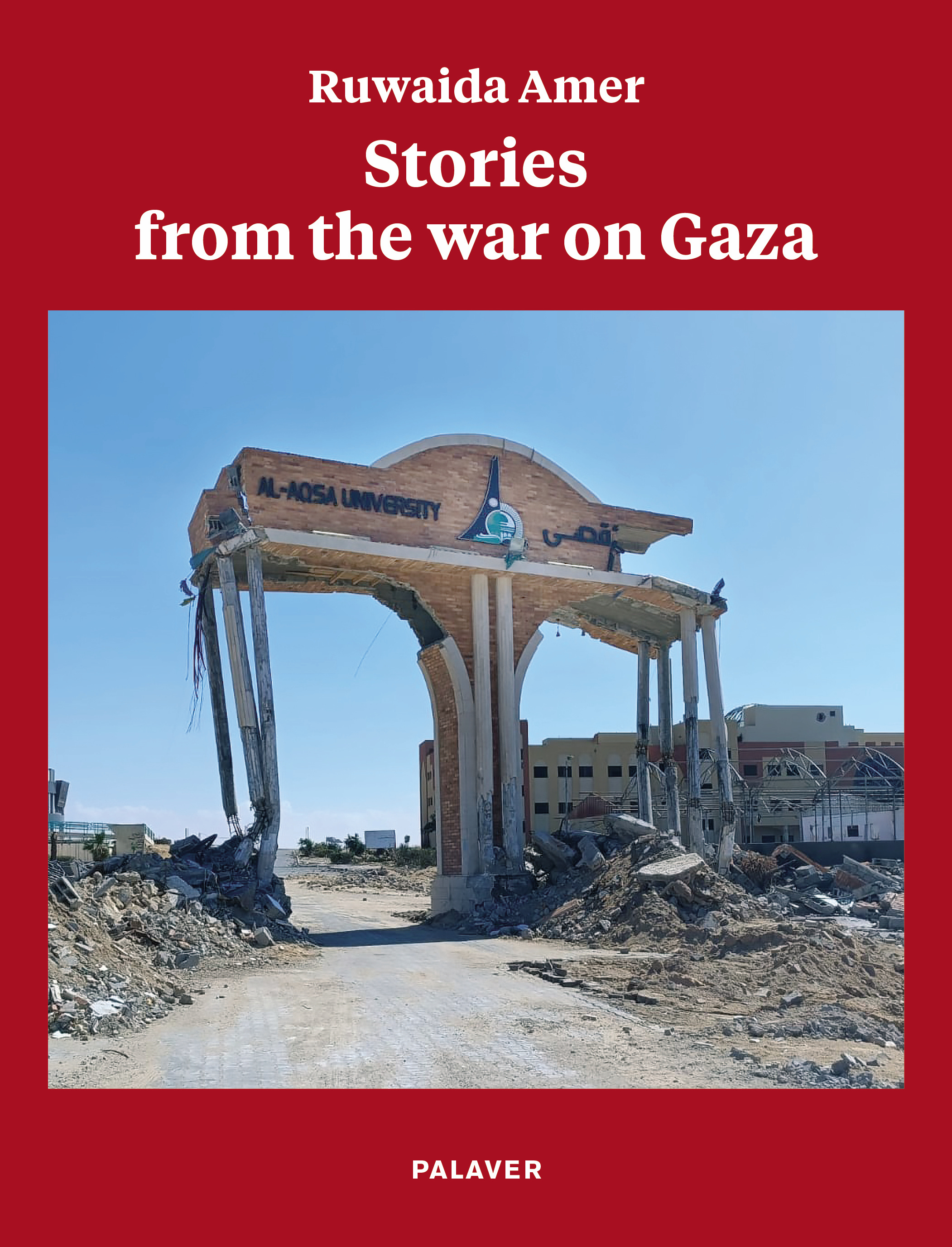
Photo courtesy of Deborah Morris
When Amer speaks, her voice carries a deep fatigue. Not the kind which comes from a lack of sleep, but a weariness shaped by years of strain and loss. But beneath it is a quiet steadiness. She speaks with clarity about her work and its importance, aware of the weight it carries and unwavering in her belief that these stories matter.
Teaching is not simply a profession for Amer. It is a responsibility.
The war has destroyed schools and left children years behind in their education. She now travels to tents and makeshift communities where families have fled bombs and bullets, teaching science, Arabic, and basic literacy. Even so, the gaps are profound.
“Many [children] don’t know… basic information [such as] Arabic or math,” she explains. Two years of disrupted learning during COVID were followed immediately by the war. Eleven- and twelve-year-olds struggle to read or write in Arabic. Childhoods, she says, have been overtaken by survival and the burden of caring for others.
“The war destroyed all the dreams,” Amer says, simply.
The scale of loss contained in such a statement is almost unfathomable. And yet, even as the future remains uncertain, she continues to imagine ways forward.
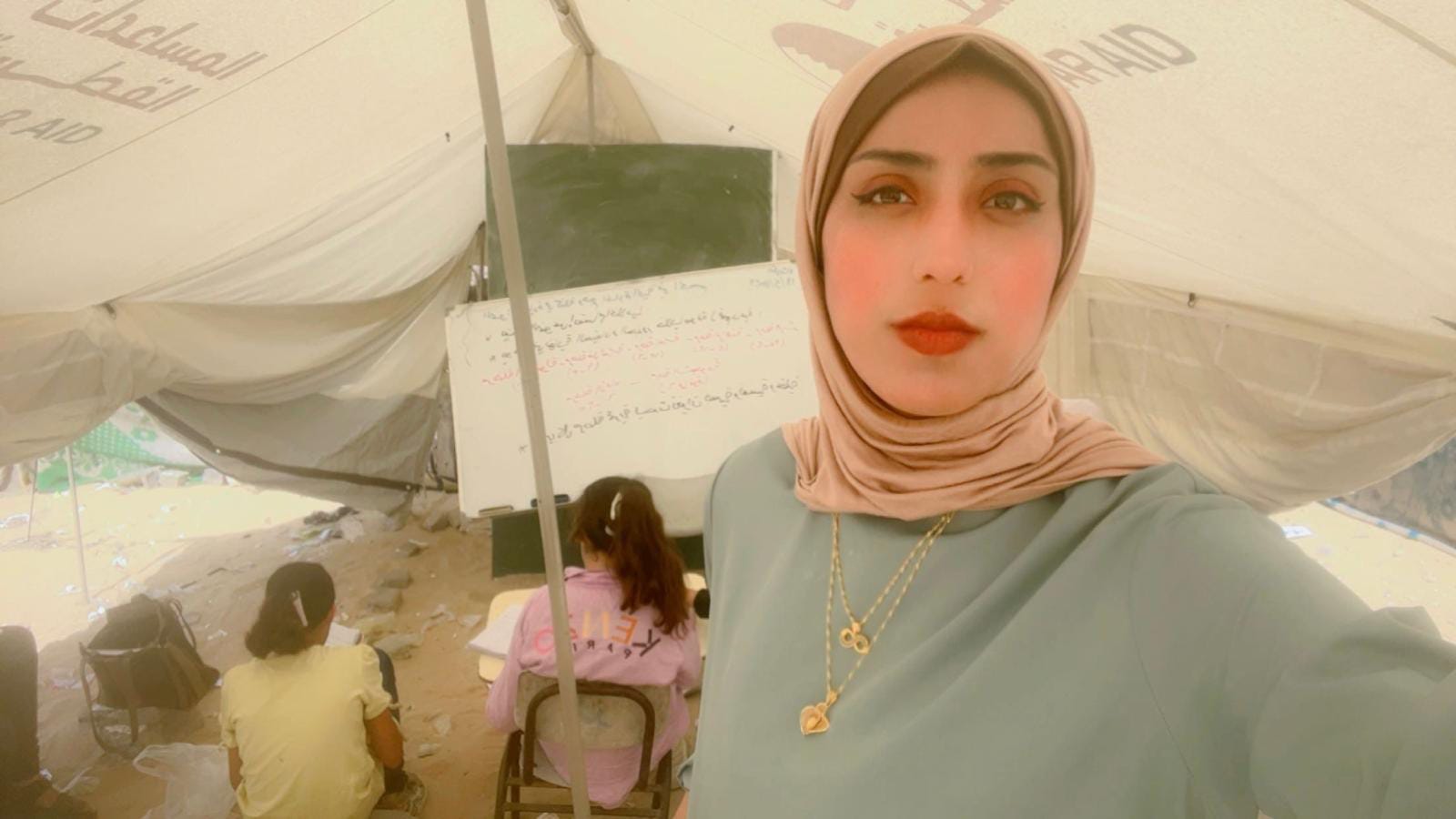
Photo by Ruwaida Amer
“I want to help the children [by] starting a small project [to help] children return to their education,” she says. The hope she describes is fragile, but it exists.
That same resolve underpins her journalism.
Palestinian journalists, particularly those working in Gaza, operate under extraordinary risk. Every story carries the possibility of danger. Documenting daily life, speaking with sources, even moving through the city requires constant vigilance. Despite the limited attention this reality receives in mainstream media, it is widely known that the Israeli military targets Palestinian journalists.
“It is very hard for journalists… they [the Israeli military] can target you at any time, anywhere. Your family, the people you want to interview,” Amer says.
Her path into war journalism reflects that of many Palestinian reporters. She began as a storyteller, drawn to documenting lives and communities which mattered to her. After October 2023, that instinct sharpened into necessity. Covering Israel’s war on Gaza became not only her work, but a means of survival, resistance, and truth-telling in the face of narratives that sought to erase lived experience.
“I don’t know why I started to cover the war,” she reflects. There was no defining moment, no clear beginning. She simply continued doing what she had always done. Telling stories, making documentaries while the war touched everything.
Many of the stories in her book focus on everyday details. Amer explains these aspects reveal how profoundly the war has reshaped life in Gaza. She writes about her students who have passed, about family members, and about fragments of her own life. Each story, she insists, matters.
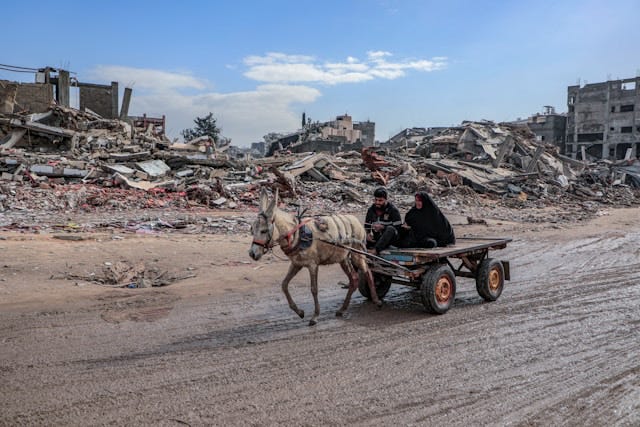
Photo by Mohammed Ibrahim
However, one piece weighs heavier than the rest. It was the most difficult she has written, both mentally and physically, because it reflects the daily reality of survival in Gaza.
In the article “We Are Starving”, Amer documents the man-made famine caused by Israel’s blockade and obstruction of aid. She describes how prolonged hunger stripped people of dignity, making them feel less than human. While much of the world cannot imagine life without food, she and those around her have endured over six months of starvation. She speaks of exhaustion, bodies depleted, and the limits of endurance.
“Sometimes I feel like I want to die because I want to eat something,” she admits.
Yet, she goes on.
For Amer, the work is not optional. “The Gaza Strip deserves to be talked and written about,” she says. “What we are experiencing is not a normal thing. It’s a very hard situation, and you need to keep talking and writing [about it].”
“When I write, I feel better,” she adds, expressing how writing is both a refuge and a tool. A way to process pain, assert humanity, and ensure truths are not lost to silence.
Even amid destruction, Amer does not surrender to despair. Her work in both teaching and journalism, rests on the act of witnessing. To record, to remember, to insist on attention in a world that too often looks away. What she offers is not spectacle or simplification, but presence.
A steady refusal to let daily life in Gaza be reduced to numbers, headlines, or abstractions.
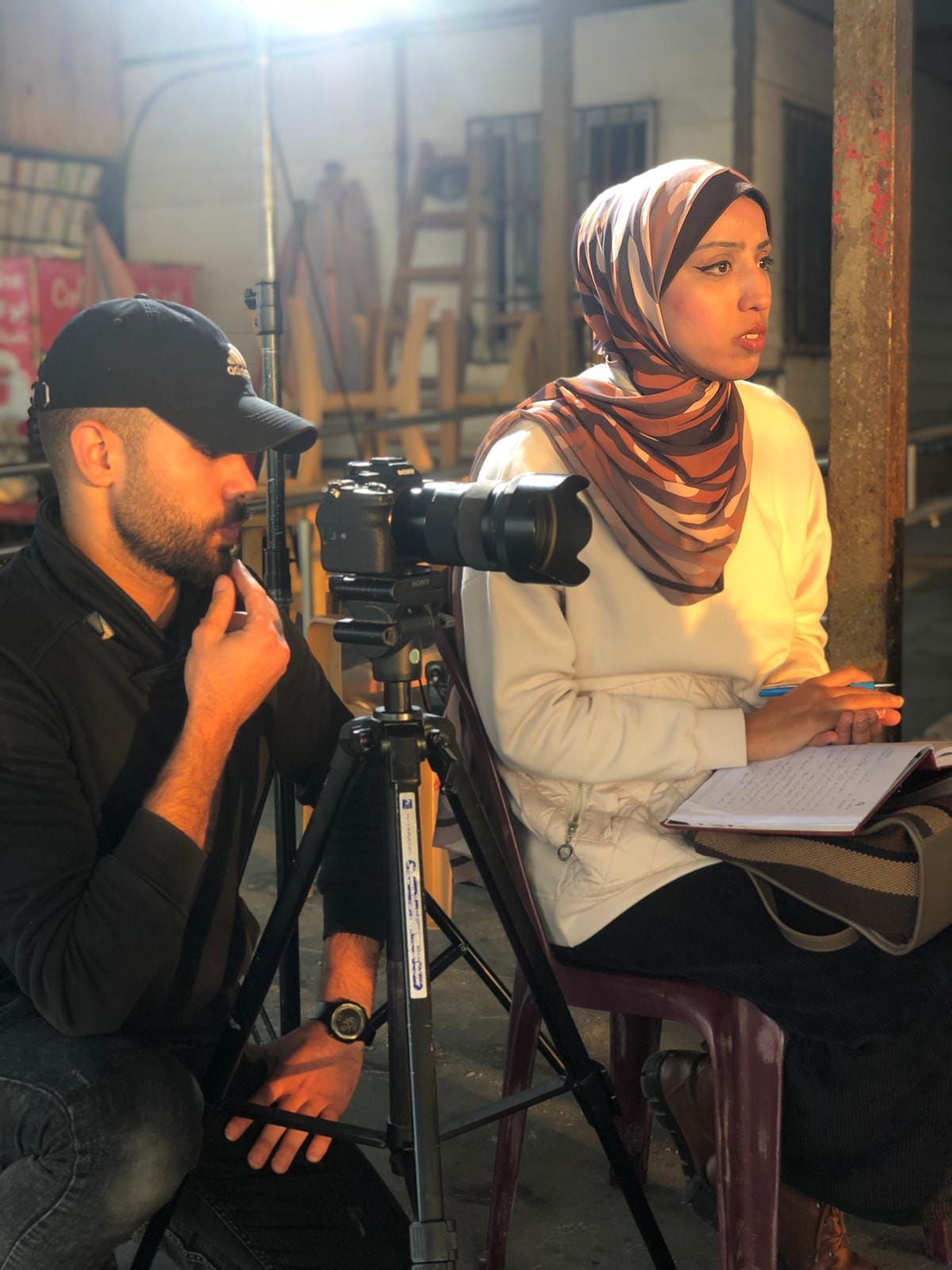
Photo by Ruwaida Amer
Speaking with her, it becomes clear these stories are not written with the expectation of resolution. They are written because silence would be a greater loss. Telling the truth is a way of remaining human under conditions designed to erode that very idea. Her writing does not promise redemption or easy hope, but it affirms something quieter and more enduring.
The belief that lives lived under siege still matter, and that being heard is itself a form of survival.
When the call ends, the distance between Gaza and Melbourne returns to view.
But Amer’s words linger, carrying with them the weight of lives weathered and stories entrusted to the page. To witness is no longer only her task. It now belongs to those who read her words, hear her voice, and choose whether to carry these stories forward rather than allow them to fade into obscurity.
Stories from the War on Gaza can be purchased as a book for $18 (plus postage) through https://www.palaver.com/contact. All profits will go to Ruwaida Amer and her family to assist in rebuilding their lives in Gaza. A free PDF version is available here.